Oshi Casino Complaints and Reputation: How to Read Player Reports
 Available in US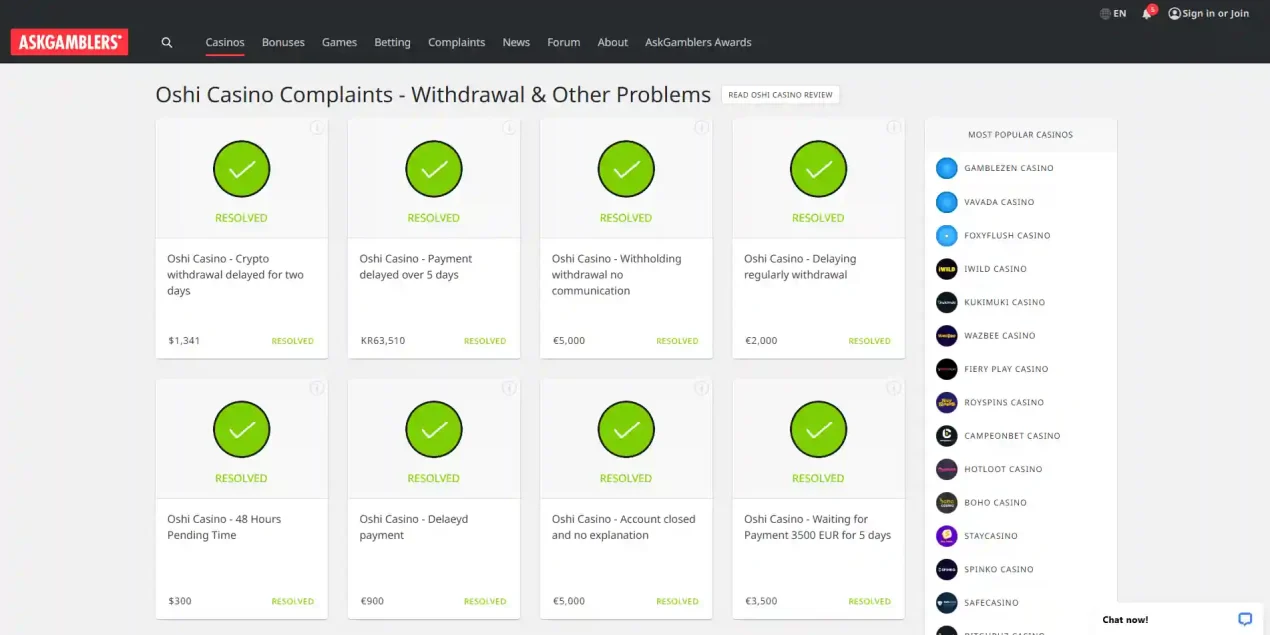
Content
Short answer: Oshi has a visible complaint history covering withdrawals, account access and bonus-term disputes. Current AskGamblers records and 2026 Casinomeister coverage include cases with different outcomes, including matters recorded as resolved. Those records are useful evidence about individual disputes, but they are not a complaint rate and they do not establish a typical payout delay or a universal operator practice. The right way to read them is case by case: check the date, disputed amount, verification status, bonus involvement, operator response, mediator finding and final status. Broader conclusions should rest on stronger evidence such as licence registers and regulator records.
Complaint records are signals, not statistics
A complaint page can answer a useful question: what kinds of disputes have reached a public mediation platform, and how were those individual cases handled? It cannot answer a different question unless the platform publishes a valid denominator: what percentage of all Oshi withdrawals become complaints. Without a reliable denominator for all Oshi transactions or accounts, complaint records cannot produce a meaningful complaint-rate percentage.
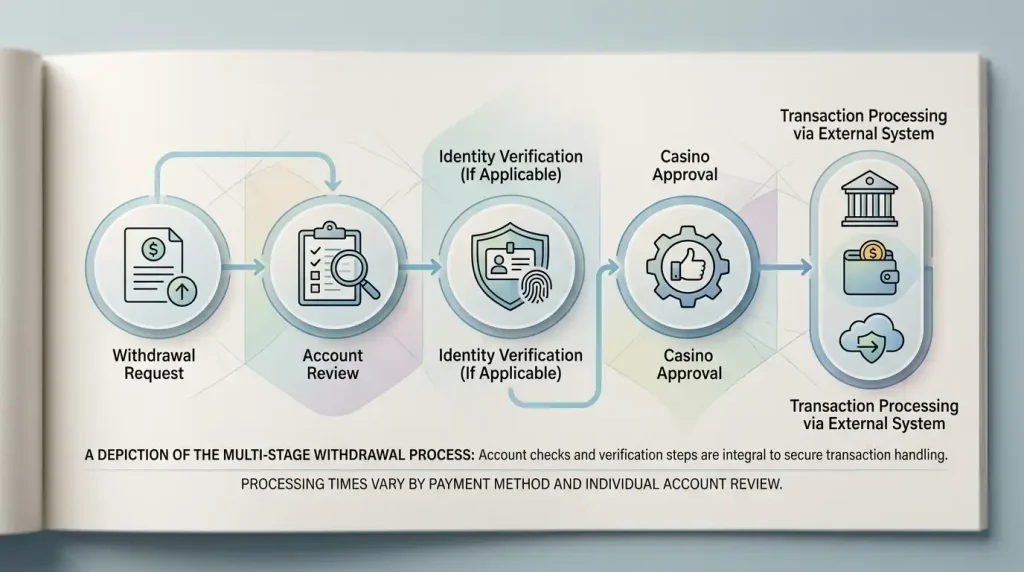
The same rule applies to timing. A player report that a withdrawal was pending for two days proves that the player reported a two-day wait in that case. It does not prove that two days is Oshi’s normal withdrawal time. For payment mechanics and payout stages, use the separate Oshi withdrawals.
That distinction protects readers from two opposite errors. One dramatic complaint should not be turned into a brand-wide accusation, while a resolved complaint should not be treated as proof that every dispute ends well. Public cases are samples with context, not a controlled performance dataset.
What Oshi complaint records commonly involve
Current Oshi complaint records include withdrawal delays, account issues and bonus-term disputes. Many cases on complaint platforms are recorded as resolved, which matters because the opening allegation is not always the final outcome.
For a useful reading, separate the complaint category from the final status. A withdrawal complaint may involve KYC, a payment route, a bonus balance or a communication problem. An account issue may involve access, account review or terms. The complaint title alone does not establish which factor caused the dispute or whether the matter was later resolved.
Complaint records are therefore best used to identify recurring questions to ask before a large deposit: which withdrawal route applies, whether KYC is outstanding, how an active bonus affects cashout and which support channel handles the problem. They do not establish a typical payout delay or a complaint rate.
Resolved complaint records need their full context
Oshi also appears in 2026 Casinomeister complaint coverage. A resolved case is useful because it shows that the initial complaint and the final outcome can differ. The important details are the issue raised, the operator response, any account or bonus conditions involved and the final status recorded by the mediator.
That prevents a common mistake: repeating only the accusation or only the resolution. A fair reading keeps both in view and does not turn one dispute into a statement about every Oshi account.
Unresolved cases show the limits of complaint data
Unresolved complaint records show a different outcome, but they still need to stay at case level. An unresolved status can reflect disagreement over account records, bonus conditions, KYC, payment handling or the information available to the mediator. It does not establish a universal Oshi policy or a normal payout time.
For Australian readers, the useful lesson is to keep transaction records and support messages, note whether a bonus was active, and identify the licence-related complaint route that applies if direct support does not resolve the issue.
The seven fields to check in any Oshi complaint
| Field | Why it changes the interpretation |
|---|---|
| Date | Older cases can involve a former operator, old terms or a different payments setup. |
| Jurisdiction | A complaint from Austria, Finland or another market may involve terms or payment options different from those relevant to Australia. |
| Disputed amount | It defines the individual case but should not be averaged into a brand claim without a valid dataset. |
| Verification status | A withdrawal dispute can turn on whether identity or payment checks were complete, but exact KYC requirements must still come from a current official source. |
| Bonus involvement | Bonus disputes can depend on promotion-specific wagering, max-cashout or eligibility rules that should not be generalised. |
| Operator response | A complete response can add records or terms that are missing from the player’s initial account. |
| Final status | Resolved, rejected, closed and unresolved are materially different outcomes. |
This framework is more useful than counting negative headlines. It forces each report back to evidence that can be checked.
Complaints alongside licensing and support information
Complaints describe individual disputes. Licensing records describe the operator’s regulatory position. Support channels describe how a user can seek help. Awards and review-site recognition describe public reputation. These are different kinds of information and one should not be used as a substitute for another.
For Oshi, complaint records include withdrawal delays, account issues and bonus-term disputes, with many cases recorded as resolved. That can help a reader understand possible friction points, but it does not establish a complaint rate or a typical payout delay. The broader trust picture also includes Novatrix’s overseas licensing, ACMA history, live chat and email support, and public reputation recognitions.
If you have an Oshi dispute, keep a clear record
Keep transaction references, dates, account messages and support conversations together. Note the disputed amount, payment method, bonus involvement and any KYC request so the sequence is easy to explain.
Start with Oshi support, then identify the complaint route connected to the applicable overseas licence if the matter remains unresolved. Do not assume ACMA provides private dispute resolution for Oshi as an Australian-licensed operator, because Oshi is not listed in the Australian licensed-provider register.
What Australian readers should not assume
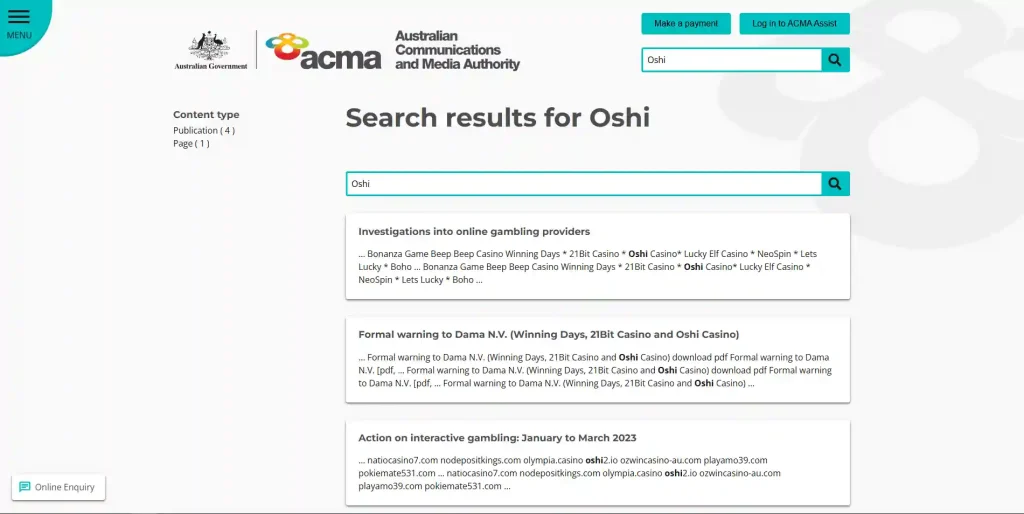
A complaint route is not the same thing as Australian regulatory protection. Oshi does not appear in ACMA’s Australian licensed-provider register, so ACMA should not be treated as a private dispute-resolution service for an Oshi withdrawal or bonus case.
ACMA’s historical action is still important as regulatory context, but the practical complaint route for an individual account dispute depends on the operator’s support process, any applicable foreign licence procedure and the rules of the mediation platform being used. The absence of an Australian licence also does not turn every player allegation into a regulator finding.
For the wider product picture, including games, payments and account features, return to the Oshi Casino Australia review.
Questions that make a complaint record more useful
When reading an Oshi complaint, start with the date and jurisdiction, then identify the disputed amount, payment method, KYC status and whether a bonus was involved. Next, separate the player’s allegation from Oshi’s response and from the mediator’s final case status. That prevents one side’s claim from being repeated as though it were an established brand-wide fact.
A resolved complaint can show that a dispute reached an outcome; an unresolved complaint can show where the parties or mediator remained apart. Neither one by itself produces a typical payout time or complaint rate. For a current account problem, keep transaction references, support messages and account notices together and use the complaint route connected to the applicable overseas licence if normal Oshi support does not resolve the issue.
Before escalating an Oshi complaint
Start by writing down the sequence in plain terms: what happened, when it happened, the amount involved, the payment method, whether a bonus was active and whether Oshi requested KYC. Keep transaction references and support conversations together. A clear timeline makes it easier to distinguish a payment delay from a bonus dispute, an account-access problem or an identity-review issue.
Use Oshi’s live chat or email support first and keep the response. If the matter remains unresolved, identify the complaint route connected to the applicable overseas licence. Do not assume that ACMA provides private dispute resolution for Oshi as an Australian-licensed operator, because Oshi is not listed in the Australian licensed-provider register.
How to compare several complaint records
Look for patterns only after keeping each case separate. Compare the issue category, date, jurisdiction, bonus involvement, KYC status, operator response and final status. Several complaints about withdrawals can still involve different causes and outcomes. Likewise, several resolved cases do not prove that every future dispute will be resolved.
Complaint records are most useful as prompts for account decisions. If repeated cases make you concerned about withdrawals, ask Oshi about the available cashout route and account requirements before depositing heavily. If bonus disputes are the concern, read the promotion conditions before opting in. The goal is to connect the complaint topic to the part of the account that can be understood before money is committed.
For operator and licence context, see Oshi licence and trust.
For the Australian regulatory position, see Oshi Australia legal status.
For account setup and KYC, see Oshi registration and KYC.
FAQ
Does Oshi Casino have complaints about withdrawals?
Yes. Current public complaint records include withdrawal-related cases. Each case should be read by date, verification status, disputed amount, operator response and final outcome rather than generalised into a typical payout delay.
Are all Oshi complaints unresolved?
No. Current complaint records include Oshi cases marked as resolved, while other records can have different outcomes. Each case should be checked individually rather than used as proof of a brand-wide pattern.
Do complaint sites prove that Oshi is safe or unsafe?
No. They provide case-level reputation evidence. Licensing and Australian regulatory status require primary register and regulator sources.
What should I save before filing a complaint?
Keep transaction records, withdrawal status, relevant account history, bonus terms, verification status, support transcripts and the exact remedy requested.
This material was created by the Oshi Australia Guide team.
Related posts
Is Oshi Casino Legal in Australia? ACMA, Licensing and Blocking
Oshi Casino Withdrawals: Methods, Verification and Payout Checks